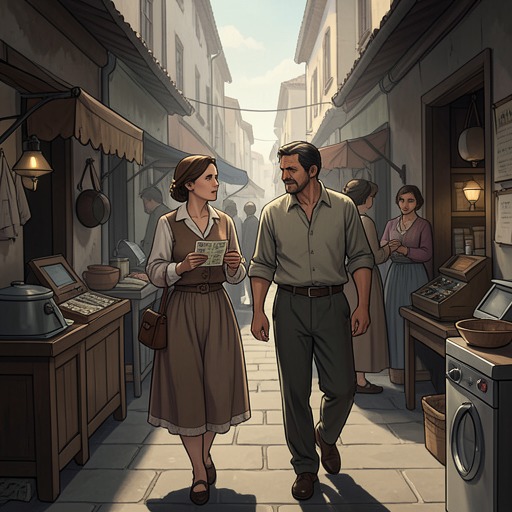
Nina ritrova Tito e lo affronta
Senza sangueNina finds Tito in a café and confronts the last surviving man among the three who witnessed her father's murder. Their meeting sets private testimony against decades of silence: Tito recounts the machinery of postwar impunity, but his account cannot undo his failure to speak, and Nina's questions make that failure personal and immediate.
The Meeting and Recognition
The encounter begins in an ordinary café. Nina and Tito sit opposite one another at a small table in a corner, order wine, and smoke cigarettes. They talk about commonplace things, including lottery winners and the way a winner tends to tell a child the secret first. Tito muses that there might be a moral in such stories, though he has never understood it; Nina distinguishes between stories that have a moral and those that do not. The casual exchange delays the confrontation without dissolving its purpose.
Tito then says that he knows who Nina is and why she has come. He identifies the central fact plainly: many years earlier, she saw three men kill her father in cold blood, and he is the only one of the three still alive. He understands that she has travelled there to find him. Nina does not answer at first. After a silence, she says that as a child her name was Nina, but that everything ended on that day and nobody called her by that name again. Tito responds that he liked the name. The exchange makes the meeting more than an inquiry into a crime: it brings the child who disappeared from ordinary life into the room with the adult who remembers her.
The Child Beneath the House
As Nina presses him to remember, Tito finally sees the child in the woman before him. Her face recalls the girl lying beneath the house, whom he remembers as immaculate, right, and perfect; he recognizes the same eyes and a forceful calm beneath her tired beauty. The resemblance collapses the distance between the wartime hiding place and the café. Tito experiences the past not as a safely completed episode but as something suddenly present, asking himself whether he is here or then, and whether he has ever been in any moment other than this one.
Tito says that he remembers. For years, remembering was almost all he did, yet he never told anyone that Nina had been beneath the farmhouse that night. At first fear kept him silent. Later, silence became easier to maintain as time passed, people turned toward the future, and the war seemed buried and no longer of interest. His account gives the concealment two phases: an immediate fear of disclosure, followed by the more durable excuse of a society eager to forget.
The possibility that the daughter of Manuel Roca was still alive reopened what Tito had tried to leave buried. He heard that she was being hidden in a village in the south of the country, and later someone claimed to have seen her. Her survival seemed incredible to him, but the report made him fear what she might remember: what a child could have seen or heard, and whether she might recognize his face. He briefly persuaded himself that nothing would come of it. Salinas's strange death ended that reassurance and helped turn a suppressed memory into a perceived threat.
A Postwar Plot of Silence
Tito recounts how suspicion gathered around Nina after Salinas died and Ricardo Uribe was implicated. The country, he says, was moving forward with extraordinary speed and forgetting the war, but there remained a whole world of people who had never emerged from it. Tito counts himself among them. For that group the war was not over, and Nina's possible knowledge made her dangerous. The account describes a society divided between public forward motion and former combatants still governed by the unresolved conflict.
The men discussed Nina for a long time before deciding that she should be eliminated. Tito calls the decision terrible but logical within their thinking: Salinas's death had not been accepted, and the possibility that Nina knew something seemed to demand action. They assigned the task to the Count of Torrelavid, a wartime double agent who worked for the opposing side while remaining one of their own. The conspiracy therefore did not arise from a legal investigation into Nina's father's murder; it was a private effort to control the risks created by what survivors might remember.
Tito explains that the Count confronted Uribe with a choice: face a lifetime in prison for Salinas's murder or disappear and leave Nina behind. Uribe, whom Tito describes as a coward, feared prison despite the claim that no court could have convicted him. He left Nina with the Count and went away. About ten years later he died in a remote village beyond the border, leaving a statement that he had done nothing and that God would pursue his enemies to hell. The episode extends Nina's confrontation beyond Tito's own silence, showing how threats, flight, and self-exculpation carried the wartime struggle into the aftermath.
Competing Accounts of Violence
Later in their conversation, Nina introduces another account of the night at Mato Rujo. She describes Uribe lifting the Count's cards and slowly revealing them one by one, then leaving the gathering politely. Nobody laughed or dared to speak; the people present had never seen a poker hand like it. Nina challenges Tito to explain why that story should be considered more false than the story he has told her. The exchange makes the past a contest between accounts, not a settled record. Tito can narrate what he knows, but Nina refuses to grant his version an automatic authority.
Nina also distinguishes between what she knows and what she can remember. She says that she was beneath the house and could not see; she heard things so absurd that they seemed like a dream, and the fire made them vanish. Children, she observes, have a particular talent for forgetting. What she now knows has been told to her, so she cannot be certain whether those who recounted it lied. She describes the reported killing of her brother: the men entered the house, Uribe shot him, Salinas shot him too, and el Gurre pressed a machine-gun barrel into his throat and killed him with a short burst. She says that el Gurre himself liked telling the story. Her account places both the limits of childhood memory and the circulation of perpetrators' stories at the center of the confrontation.
The accusation is sharpened by the contrast between Tito's ordinary present and his wartime inaction. Nina points to his worn overcoat, the grey case in which he carefully puts his glasses, the clean windows of his kiosk, and the care with which he looks both ways before crossing the street. These habits make him appear normal; they do not answer for the fact that he saw her brother die, a child with a rifle in his hands, and did nothing. Tito replies that they were soldiers. Nina asks what that means. The exchange strips the word of its power as a complete explanation: a role in the war does not settle the moral question of what he witnessed and failed to do.
The Confrontation's Unresolved Reckoning
Nina's questioning does not produce a legal judgment or a simple reconciliation. Tito has admitted that he kept her presence beneath the farmhouse secret, and he has narrated the later plan to eliminate her, but the account itself remains marked by uncertainty: some of Nina's knowledge came from other people, and Tito's version is also testimony delivered years after the events. Their meeting creates a space for disclosure that the wider postwar world had not provided, while exposing how incomplete disclosure remains when memory is fractured and the survivor's questions concern not only what happened but what a witness did nothing to prevent.
The confrontation's force lies in the collision between a child made to disappear and a man who continued into ordinary life carrying the knowledge of where she had been. Nina's forgotten or inherited fragments, Tito's years of recollection, and the stories told by men such as el Gurre do not combine into an uncomplicated record. They instead make remembrance a struggle over who may tell the past, what can be trusted, and whether the word soldier can contain the responsibility of having watched a child die. Tito's final answer does not resolve that struggle; Nina's question remains unanswered.